Bachelor of Science in Microbiology
A three-year Periyar University degree · Komarapalayam, Tamil Nadu
Open to +2 students with any one of Botany, Zoology or Biology. No entrance test, no NEET.
Annual Fee (MQ)
2026-27 · GQ as per Govt norms
Biology Subject
Botany, Zoology or Biology in +2
Practical Every Core
A practical in each core subject
University Degree
Autonomous, NAAC accredited college
Programme Overview
B.Sc Microbiology is a three-year arts and science degree on microorganisms and their uses. Year 1 covers Fundamentals of Microbiology, Microbial Physiology and Metabolism, biochemistry and bioinstrumentation; Year 2 covers Molecular Biology and Microbial Genetics, Immunology and Immunotechnology, clinical laboratory technology and food processing; Year 3 covers Bacteriology and Mycology, Virology and Parasitology, Recombinant DNA Technology, environmental, agricultural, food and pharmaceutical microbiology, a project with viva voce and an internship or industrial visit.
JKKN College of Arts and Science is an autonomous college affiliated to Periyar University, on NH-544 at Komarapalayam in Namakkal district, Tamil Nadu, between Salem and Erode. B.Sc Microbiology here is a self-finance programme with an annual management-quota fee of ₹34,000 for 2026-27. Comparing colleges across the state? Read our guide to B.Sc Microbiology colleges in Tamil Nadu.
Eligibility & Admission Criteria
Requirements for joining B.Sc Microbiology, as set by the Periyar University regulations
Academic Qualification
- •Pass in the Higher Secondary (+2) examination
- •Any one of Botany, Zoology or Biology
- •No minimum percentage in the regulation
- •Merit-based admission; reservation as per Tamil Nadu Government norms
Accepted Streams
- •Academic stream with Botany, Zoology or Biology
- •Vocational stream: Agriculture, Home Science or Poultry
- •Chemistry is not required by the regulation
- •No entrance test - NEET is not needed
Documents Required
- •10th & 12th Mark Sheets
- •Transfer Certificate
- •Community Certificate
- •Passport Size Photographs
- •Aadhaar Card Copy
Programme Learning Framework
Comprehensive learning pathway designed to develop expertise in microbiological sciences
Learning Period I
- •Fundamental of Microbiology and Microbial Diversity24UMBC01
- •Fundamental of Microbiology Practicals24UMBCP01
- •Basic and Clinical Biochemistry24UMBDE01
- •Foundation Course - Introduction to Microbial World24UMBFC01
Learning Period II
- •Microbial Physiology and Metabolism24UMBC02
- •Microbial Physiology and Metabolism Practicals24UMBCP02
- •Bioinstrumentation24UMBDE02
- •Sericulture24UMBSE01
- •AI Acceleration with Microbiology24UMBSE02
Programme Learning Outcomes
Core competencies you will develop through this programme
Microbiological Expertise
Comprehensive understanding of bacteria, viruses, fungi, and parasites including their classification, morphology, physiology, genetics, and pathogenicity.
Laboratory Practice
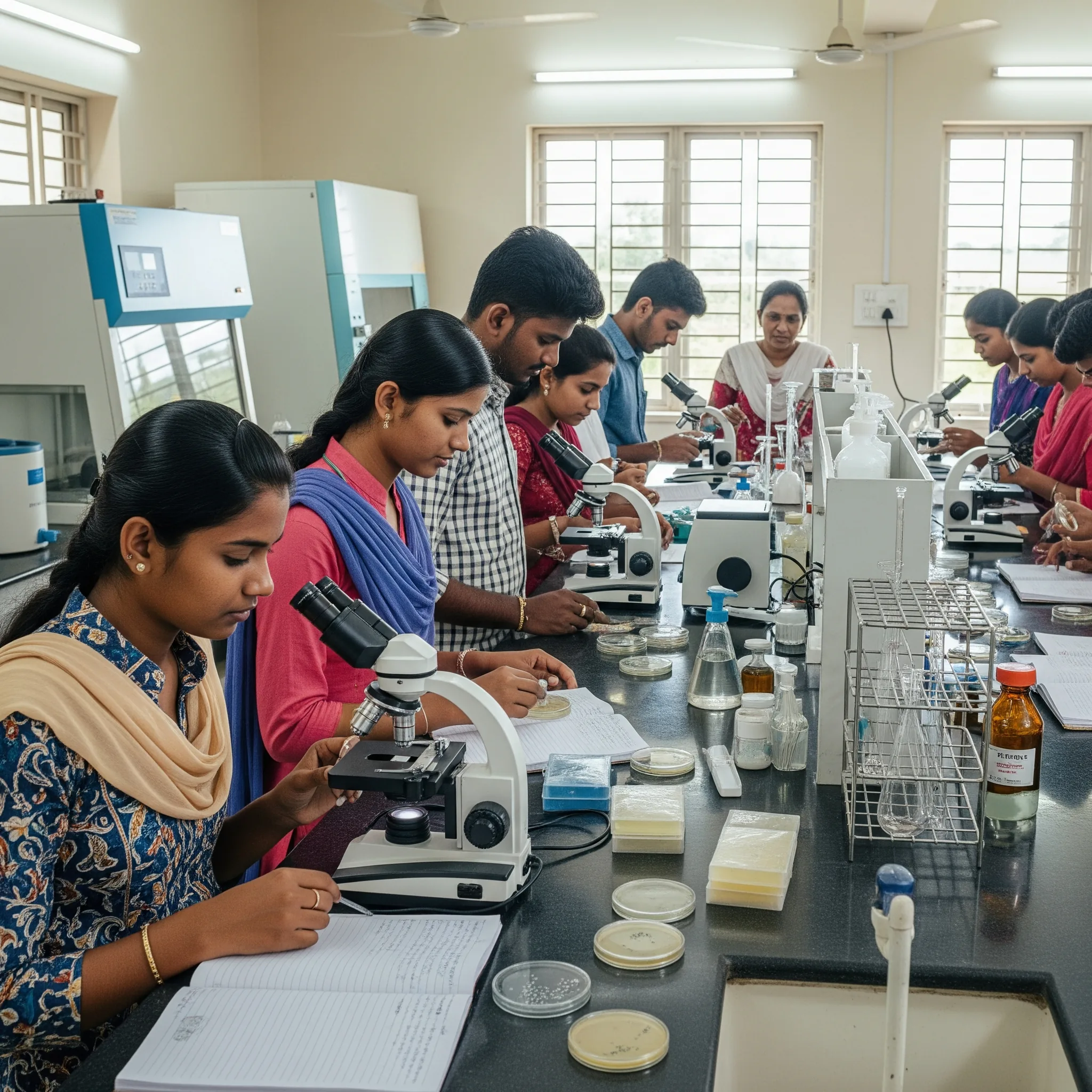
Work with aseptic technique, microscopy, culture methods, staining and biochemical tests through the practical in each core subject.
Immunological Knowledge
Understand immune system components, antigen-antibody reactions, immunological disorders, and vaccine development.
Industrial Applications
Apply microbial processes in fermentation technology, antibiotic production, enzyme manufacturing, and quality control.
Molecular Biology Skills
Understand DNA/RNA structure, gene expression, recombinant DNA technology, cloning techniques, and genetic engineering.
Project Work
Carry out a project with viva voce and an internship, industrial visit or field visit in the final year.
Career Opportunities
Diverse career pathways for B.Sc Microbiology graduates
Clinical Microbiologist
Work in hospitals, diagnostic labs, and healthcare centers
Research Associate
Universities, CSIR labs, and research institutions
Quality Control Analyst
Pharmaceutical and food industries
Food Microbiologist
Food processing, FSSAI, and quality testing labs
Pharma Executive
Drug companies, biotech firms, and CROs
Lab Technician
Pathology labs, blood banks, and clinics
Environmental Scientist
Pollution control boards and environmental agencies
M.Sc / Ph.D Scholar
Higher studies at universities and research institutes
Employment Sectors
Practical Courses
The core practical courses in the B.Sc Microbiology syllabus
Fundamentals of Microbiology Practicals
Core Practical (24UMBCP01), Semester I.
Microbial Physiology and Metabolism Practicals
Core Practical (24UMBCP02), Semester II.
Molecular Biology and Microbial Genetics Practicals
Core Practical (24UMBCP03), Semester III.
Immunology and Immunotechnology Practicals
Core Practical (24UMBCP04), Semester IV.
Core Practical V
Semester V (24UMBCP05), with Bacteriology and Mycology and Virology and Parasitology.
Core Practical VI
Semester VI (24UMBCP06), with environmental, agricultural, food and dairy microbiology.

Why Choose Our Microbiology Programme?
Facts a family can check before choosing: fee, eligibility, affiliation and what the syllabus covers.
Published Fee
₹34,000 a year under the management quota for 2026-27; government quota seats follow Government norms.
Any One Biology Subject
Botany, Zoology or Biology in +2 qualifies under the Periyar University regulation; Chemistry and a minimum percentage are not required.
A Practical in Every Core Subject
From Fundamentals of Microbiology in Semester I to Core Practical VI in the final year.
Project and Internship
A project with viva voce and an internship, industrial visit or field visit in the final year.
Autonomous, Periyar University Degree
The college sets its own syllabus and examinations; the degree is awarded by Periyar University, Salem. NAAC accredited.
Our Senior Learners
Meet our experienced and dedicated department team
Dr.D.Hemalatha
Head of Department
P.hD., Microbial Genetics
S. Kayathri
Assistant Professor
M.Sc,B.Ed,M.Phil.,Life Science
S. Kamali
Assistant Professor
M.Sc., Biochemistry
Dr.D.Hemalatha
Head of Department
P.hD., Microbial Genetics
S. Kayathri
Assistant Professor
M.Sc,B.Ed,M.Phil.,Life Science
S. Kamali
Assistant Professor
M.Sc., Biochemistry
Dr.D.Hemalatha
Head of Department
P.hD., Microbial Genetics
S. Kayathri
Assistant Professor
M.Sc,B.Ed,M.Phil.,Life Science
S. Kamali
Assistant Professor
M.Sc., Biochemistry
Dr.D.Hemalatha
Head of Department
P.hD., Microbial Genetics
S. Kayathri
Assistant Professor
M.Sc,B.Ed,M.Phil.,Life Science
S. Kamali
Assistant Professor
M.Sc., Biochemistry
Frequently Asked Questions
Common queries about B.Sc Microbiology
Begin Your Journey in Microbiology
B.Sc Microbiology admission for 2026-27 is open to +2 students with any one of Botany, Zoology or Biology.
B.Sc Microbiology admission 2026-27 · Fee structure · B.Sc Microbiology colleges in Tamil Nadu