Bachelor of Science in Physics
Unlock the Mysteries of the Universe Through Science
Annual Fee (MQ)
2026-27 · GQ as per Govt norms
University Affiliation
Autonomous college, Salem region
+2 Eligibility
Maths, Physics and Chemistry
Accredited Institution
Autonomous, UGC recognised
Programme Overview
The Bachelor of Science in Physics is a comprehensive three-year undergraduate programme designed to provide Learners with in-depth knowledge of fundamental physics, quantum mechanics, electromagnetism, thermodynamics, and modern physics. This UGC-recognized programme offers a perfect blend of theoretical foundations and practical laboratory experience, preparing graduates for diverse career pathways in scientific research and technology.
Our progressive education philosophy ensures that Learners develop scientific temperament, analytical thinking, and problem-solving skills through experiential learning. The curriculum integrates classical physics with modern computational techniques, electronics, and material science, equipping graduates with skills demanded by research institutions, technology industries, and academic organizations worldwide.
JKKN College of Arts and Science is an autonomous college affiliated to Periyar University, on NH-544 at Komarapalayam in Namakkal district, Tamil Nadu, between Salem and Erode. B.Sc Physics here is a self-finance programme with an annual management-quota fee of ₹25,000 for 2026-27. Comparing options across the state? Read our guide to B.Sc Physics colleges in Tamil Nadu, which lists the NIRF 2025 ranked colleges and the Namakkal district options.
Eligibility & Admission Criteria
Requirements for joining the B.Sc Physics programme, as set by the Periyar University B.Sc Physics regulations
Academic Qualification
- •Pass in the Higher Secondary (+2) examination
- •Mathematics, Physics and Chemistry as subjects
- •Tamil Nadu State Board or an equivalent board
- •Merit-based admission; reservation as per Tamil Nadu Government norms
Accepted Streams
- •Mathematics, Physics, Chemistry, Biology group
- •Mathematics, Physics, Chemistry, Computer Science group
- •Any +2 group that includes Mathematics, Physics and Chemistry
- •Commerce and Arts streams are not eligible
Documents Required
- •10th & 12th Mark Sheets
- •Transfer Certificate
- •Community Certificate
- •Passport Size Photographs
- •Aadhaar Card Copy
Programme Learning Framework
Comprehensive learning pathway covering classical and modern physics with hands-on laboratory experience
Learning Period I
- •General Tamil - I24UGTA01
- •General English – I24UGEN01
- •Core – I, Properties of Matter & Sound24UPHC01
- •Core Practical – I, Properties of Matter Experiments24UPHCP01
- •Generic Elective Mathematics – I24UMAGE1
- •Non-Major Elective – I (NME), Physics For Everyday Life24UPHNM1
- •Foundation Course, Introductory Physics24UPHF01
- •Generic Elective Physics – I (Elective)24UPHGE1
- •Generic Elective Physics Practical – I (Elective)24UPHGEP01
Learning Period II
- •General Tamil – II24UGTA02
- •General English – II24UGEN02
- •Core – II, Heat, Thermodynamics and Statistical Physics24UPHC02
- •Core Practical – II, Heat, Oscillations, Waves & Sound Experiments24UPHCP02
- •Generic Elective Mathematics – II24UMAGE2
- •Generic Elective Mathematics Practical24UMAGEP01
- •Non Major Elective – II (NME), Astrophysics24UPHNM2
- •SEC – I, Instrumentation24UPHS01
- •Disaster Management25UPHDIM01
- •Generic Elective Physics – II (Elective)24UPHGE2
- •Generic Elective Physics Practical – II (Elective)24UPHGEP02
Programme Learning Outcomes
Skills and competencies you will develop through this programme
Analytical Thinking
Master systematic approaches to physical problem-solving, mathematical modeling, experimental design, and data interpretation using statistical and computational tools.
Theoretical Foundation
Develop comprehensive knowledge of classical and modern physics including mechanics, electromagnetism, quantum physics, and relativity with mathematical Physics.
Laboratory Proficiency
Acquire hands-on skills in experimental physics, precision measurements, instrumentation, electronics fabrication, and modern laboratory techniques.
Computational Skills
Comprehend numerical methods, programming languages, simulation techniques, and data analysis methodologies essential for modern physics research.
Electronics Expertise
Apply analog and digital electronics concepts including circuit design, microcontroller programming, and instrumentation for scientific applications.
Professional Communication
Effectively communicate scientific findings through research papers, presentations, and technical reports while collaborating in multidisciplinary research teams.
Career Opportunities
Diverse career pathways in science, technology, and research sectors
Research Scientist
After an M.Sc or Ph.D.: ISRO, DRDO, BARC, CSIR and national laboratories
Educator / Lecturer
Schools, colleges, coaching institutes, and universities
Electronics Engineer
Semiconductor industries, R&D labs, and tech companies
Data Scientist
IT companies, analytics firms, and research organizations
Medical Physics
After an M.Sc in Medical Physics: hospitals and radiotherapy units
Government Services
UPSC, State PSC, Indian Forest Service, and regulatory bodies
Space & Defence Research
Scientific assistant and technical posts through recruitment exams
Energy Sector
Nuclear power, renewable energy, and power corporations
Key Employment Sectors
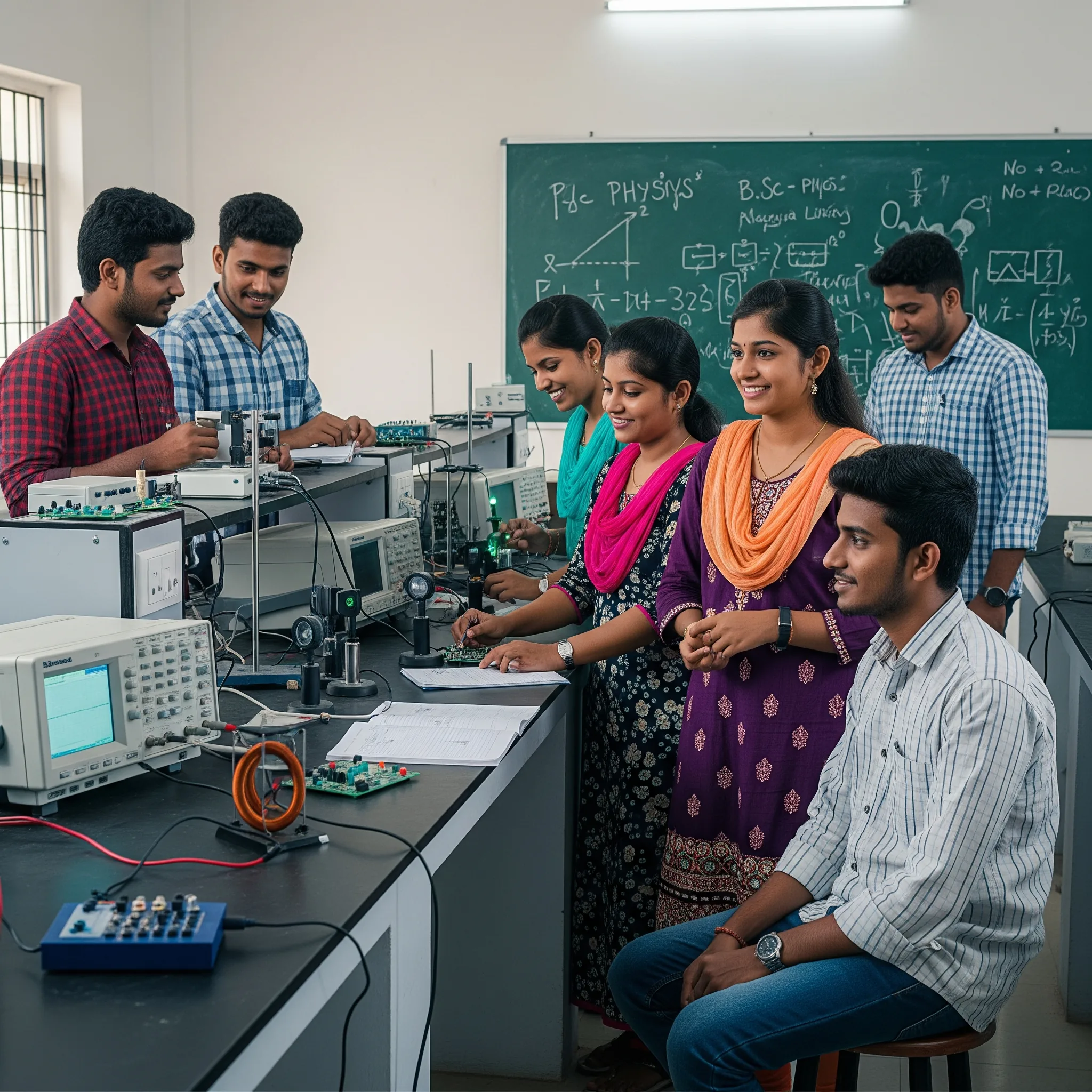
Physics Practicals
The six core practical courses in the B.Sc Physics syllabus, one in each semester
Core Practical I
Properties of Matter experiments (24UPHCP01), Semester I.
Core Practical II
Heat, Oscillations, Waves and Sound experiments (24UPHCP02), Semester II.
Core Practical III
Electricity experiments (24UPHCP03), Semester III.
Core Practical IV
Light experiments (24UPHCP04), Semester IV.
Core Practical V
General experiments (24UPHCP05), Semester V.
Core Practical VI
Electronics experiments (24UPHCP06), Semester VI.

Why Choose Our B.Sc Physics Programme?
Published Fee
₹25,000 a year under the management quota for 2026-27; government quota seats follow Government norms. Every programme fee is on the Fee Structure page.
Autonomous, Periyar University Degree
The college sets its own syllabus and examinations as an autonomous institution; the degree is awarded by Periyar University, Salem.
M.Sc Physics on the Same Campus
The college also offers an aided M.Sc Physics, so B.Sc graduates have a postgraduate route without changing campus. Other routes include IIT-JAM, JEST and a B.Ed.
Project and Internship
The syllabus includes an internship, industrial visit or field visit in Semester V and a project in Semester VI.
Reachable from Five Districts
On NH-544 at Komarapalayam, with college transport from Erode, Salem, Namakkal, Tiruppur and Coimbatore, and separate hostels for boys and girls.
NAAC Accredited
The college is NAAC accredited and UGC recognised, and publishes its NIRF data on the NIRF page.
Our Senior Learners
Meet our experienced and dedicated Physics faculty members

Dr. N. Latha
Assistant Professor
M.Sc., M.Phil., Ph.D., B.Ed.

Mr. K. Dinesh
Assistant Professor
M.Sc., B.Ed., PGDCA., D.Yoga., (PhD)

Mr. V. Yasodharan
Assistant Professor
M.Sc., B.Ed., PGDCA., D.Yoga.
Frequently Asked Questions
Common queries about the B.Sc Physics programme
Begin Your Journey in Physical Sciences
Join our B.Sc Physics programme and explore the fundamental laws that govern the universe through six semesters of theory and laboratory work
B.Sc Physics admission 2026-27 · Fee structure · B.Sc Physics colleges in Tamil Nadu